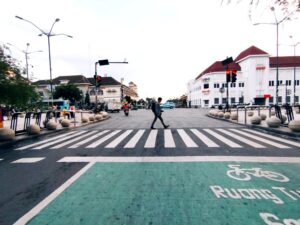
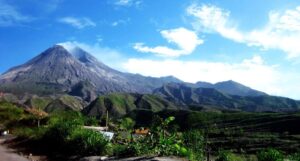
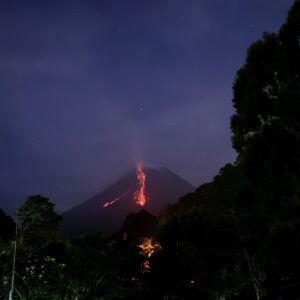
Malioboro street was originally designed as an imaginary north-south axis, considered sacred in accordance with the philosophical axis of the city of Yogyakarta, connecting Parangkusumo Beach, the Yogyakarta Palace, and Mount Merapi. There are several historical objects in this area, including the Yogyakarta Monument (Tugu), Yogyakarta Station, Gedung Agung, Beringharjo Market, Parliament Office, Vredeburg Fort, Grand Hotel De Djokja, Yogyakarta Special Region Governor’s Office Complex, and the March 1st General Attack Monument.
Malioboro street is famous for its street vendors selling typical Yogyakarta crafts and its nighttime stalls selling Jogja culinary delicacy like gudeg. It’s also a popular gathering place for artists who often express their talents through music, painting, happening art, pantomime, and more.
The street initially served as the main royal road (rajamarga) for the ceremonial activities of the sultanate. When the sultan left the inner palace and sat in Sitinggil for public ceremonies, he could see straight through Malioboro Street to the Tugu in the distance. Between Malioboro Street and the palace are two banyan trees surrounded by a square fence (waringin kurung) in the North Square. These twin symbolize the unification of two opposites.
In the 18th century, people from various ethnicities lived on this street, such as Javanese, Chinese, and Dutch. Since 1765, the Dutch and Chinese have inhabited the northern part of Yogyakarta, while the Javanese have inhabited the rest. This can be seen from the architectural form of the settlements near the southern part of Malioboro which are influenced by Chinese architecture. Meanwhile, the settlements near the northern part of Malioboro are influenced by Javanese and Dutch architecture.