
Selogriyo and Nepal van Java are a perfect combo for travelers who enjoy cultural heritage, mountain scenery, traditional villages, and authentic local experiences
Selogriyo temple is an ancient relic estimated to have been built in the 9th century AD, during the Ancient Mataram Kingdom. It is located on the eastern slope of a cluster of three hills: Condong Hill, Giyanti Hill, and Malang Hill, at an elevation of 740 meters above sea level. The temple is located in Campurejo Hamlet, Candisari Village, Windusari District, Magelang Regency.


Temple building
This classical Indonesian architecture, with a Hindu background, faces east. On the four walls of the temple, there are five niches housing statues of deities. These statues are Durga Mahisasuramardini (north wall), Ganesha (west wall), Agastya (south wall), and Nandiswara and Mahakala (east wall).
One of the unique features of this temple without any ancillary facilities is its pinnacle, shaped like a keben fruit. This pinnacle is called amalaka.
Restoration
In December 1998, the temple was destroyed by a landslide on the hill on which it stood. Reconstruction was completed in 2005.
Nepal van Java
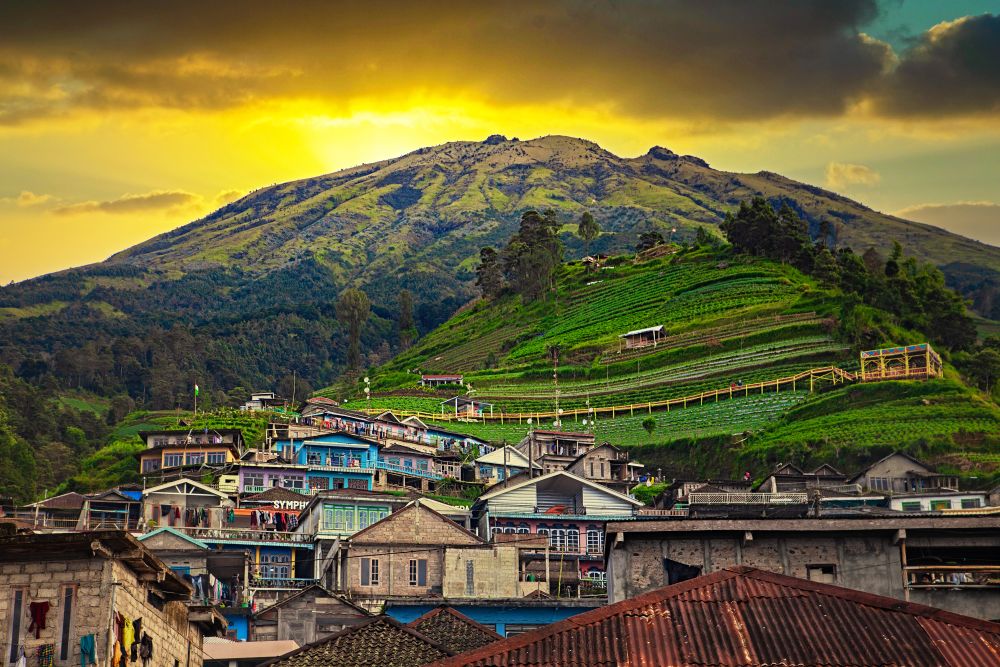
It is a small village famous for its colorful houses on the slopes of Mount Sumbing. This uniqueness lies in the houses of the residents who inhabit the mountainside. They are neatly lined up with unique shapes and distinctive colors. Furthermore, the backdrop of Mount Sumbing makes this place even more similar to Nepal. The difference is that Nepal has the snow-capped Mount Everest as its backdrop.

It is located at an altitude of around 1,700 meters above sea level, at the foot of Mount Sumbing, precisely in Butuh Hamlet, Temanggung Village, Magelang Regency, Central Java. The natural landscape and the residents’ houses are terraced and appear stacked, resembling Nepal. The best time to enjoy the stunning views of Nepal van Java is from April to June.